Sometimes, it is convenient to write emails and letters to many people at the same time like an email to an older age group, a promotion email, a marketing campaign etc. When your list of recipients goes beyond two or three names, you may have to deal with such questions as how to address two persons in an email. What should be done to deal with them?
In the process of communicating with other individuals, particularly when cold emailing, you must consider the way you would want others to treat you hence It is imperative to learn how to write an email addressing several people to build a professional reputation. Below is an instruction on how to format a mail or letter addressed to a number of people. You will find a step-by-step guide, tips, and tricks to follow as you write your professional correspondence. You will use our tips when you seek the answer to how to address two people in an email.
How to write an email addressed to two persons
When addressing multiple recipients in an email, it’s crucial to pay attention to how to address two people in an email, and it is no different from addressing two people in a letter or in person. We address the most senior person in an email the same way as we do during face-to-face meetings.
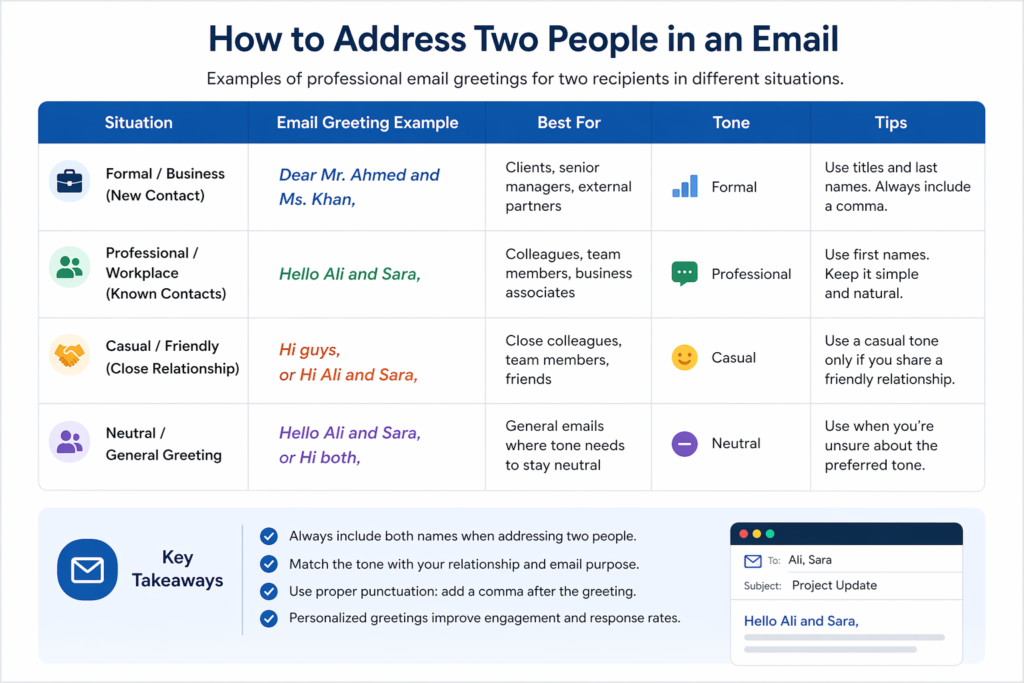
If you are addressing two people in an email while writing a business email, you need to be aware of the salutation in addition to the subject line of the email. If you’re unsure of how to address two people in an email, it’s best to include both recipients’ names in the greeting, such as “Dear John and Jane,” to ensure they both feel acknowledged and included in the correspondence. Since you are writing to friends, you can use their first name or their full name. It’s like text messaging but with more text and formality. A common greeting for friends is “Hi John,” “Hi Jane,” or even “Hey.”
The proper email greeting to address two people in an email who are your colleagues should be “Good morning,” “Good noon,” or “Good evening,” followed by their names. Additionally, when addressing colleagues, please use their full names unless they have requested you to use their first names. While it’s always best to address colleagues by their full names, it’s always best to err on the side of formality. While sending emails to potential clients, especially in outbound prospecting, it is best to use the first name of the person who might be the decision maker and cc the rest of the person.
The formal address is Mr, Mrs, or Ms, then the surname of colleagues or fellow employees. In writing an email, it may be addressed to Mr Jack Smith or Ms Jane, or you may use titles such as Dr. Prof. or Rev. and then the full name of the person, in case you do not know whether the person is male or female. This is not a very informal way of sending a greeting and one should only resort to it when communicating business-related information via email. People are always left pondering whether a comma or a period will be useful after the title in salutations in emails. Generally, you are supposed to employ a comma when addressing friends and use a period when addressing colleagues. This is the way of emailing two individuals.
Do’s and Don’ts while writing an email to more than 2 persons
Additionally, you should follow these Do’s and Don’ts to make a positive impression on the recipient when sending emails.
Do’s:
- Include a clear and descriptive subject line that can separate your email from the pack and make you stand out to your readers. Be specific and write what the email is about.
- Even if you know the recipients well, using “Hey,” or “Yo” is not professional. Use “Hi Team”, “Hello Team”, or “Hi Everyone”.
- Always be polite when asking for something. Always say “Thank you” and “Please.”
- Include your signature with your email and contact number, so the recipient doesn’t have to search for your email or phone number. Set it up to appear by default at the end of each email.
- Always proofread your email before hitting the send button, there might be grammatical or spelling errors you will miss.
Don’ts:
- Don’t write a long email. The purpose of the email is to communicate briefly. Keep it short and concise, and use only a few paragraphs.
- Avoid using humor. The recipients may misinterpret what you consider humorous.
- Do not “reply to all” unless your response is appropriate for group sharing.
- Don’t send an angry email, and do not take too long to respond. Make sure you give your message some careful consideration before sending it.
Send an email to multiple recipients without knowing them
Marketing campaigns usually require bulk emailing, for which most companies fetch email addresses from LinkedIn and then create a list to pitch their offer. The first step is to select a subject line, which should display a short message before the email appears in the inbox. A subject line summarizes your email’s purpose in approximately seven to eight words. The first line of your email should always be a greeting. Next, you need to pay attention to the body of your email to make sure it is clear and concise. A clear goal, structure, and focus are necessary for an email to be effective. It is important to remember that storytelling qualities do not work in an email, and people are more likely to lose focus and interest if the email is not short and to the point.
When possible, use bullet points to break down lengthy points. Make sure that your email has a professional tone of voice. Establish a neutral tone in order to assist the reader in concentrating and crafting a response that is in line with your expectations. Your email may be more likely to receive a response if it is error-free, meaning it may be easier for others to read and comprehend. It is also important that your email be readable, which means that the recipient can understand what you are saying.
Once you have written your mail, paste and copy it into Notepad. Then save the file in the form of a .doc. Rename it to any random name like Letter-to-Jack-from-John.doc. Open up the document and delete all the content in it. Copy it and paste it with dummy text and use bullets in between the long paragraphs. Make sure that the font is the same as the rest of the document. Rename the document as “New_document.doc”.
The last thing you need to do is make a brand new document entitled “Letter.pdf” and add your own cover letter at the top. Enter your pseudo name in the left-hand corner, and change the contents of the page so that they reflect the actual sender. Attach the signed documents to your email after printing them out, signing them, scanning them, and scanning them. Using email lead generation strategies, you can gather quality leads and send them promotional messages about your products or services. The number of responses you receive in your inbox will surprise you if you use this technique effectively.
How to Address a Letter to Multiple People?
It appears easy to compose a business letter or email until you run into one of the numerous variations to the general format. In cases where you are dealing with more than a single person, you might have to explain what you are speaking or saluting, even at the outset of the letter. Depending on the audience and the message you would like to send, you have numerous options for the right address type.
When writing to multiple recipients, it is essential to use the most popular format with the group. It is generally best to use an email format for most groups. In some cases, a typed note is more appropriate. It is up to you to understand your audience and choose a suitable form. Here is a format you can use when writing a formal letter to multiple recipients.
Address
You can either write your address or use the letterhead of your company. Dates should appear after the sender’s address, followed by the recipient’s address. You can type two addresses side by side or one on top of the other if your letter addresses two recipients. However, typing all of the recipients’ addresses might make your letter appear unappealing if you have three or more recipients. In this situation, it is best to omit the addresses.
Subject
Whenever possible, avoid using multiple subjects in one letter. You should address your letter to multiple recipients if it indicates its purpose for a specific reason.
Your letter should only cover what is relevant to the topic. If you stick to the subject, you will let your message get noticed by only a few topics. Before you hit send, make sure your email subject line is clear and engaging.
Salutation/Greeting
- When addressing less than five people, it is preferable to begin with the word dear, then their titles and names, and then a colon. Dear Ms Jorge, Mr Adil and Dr James, as an example:
- In the case of a letter to a team at work, you may use a general salutation—for example, Dear Administrative Department, Dear Publicity Department.
- It is best to use a general salutation when addressing a large group of people. For instance, When you want to send a memo to your clients or users or address your colleagues at work. The ideal salutation is Greetings, Dear Colleagues, Dear Friends.
Body
- Use general terms: It is necessary to use words that address a group if you are addressing your letter to a group. Write as if you were writing to a single person.
- Stick to simple sentences: It’s important that everyone understands your message since you’re addressing a variety of people. It’s easy to achieve this by using simple words and simple sentences.
- Consider accuracy: It is important not to mislead your audience. Make sure you present accurate information to your audience by checking your facts.
- Formality:
- Make your tone professional and official. Using courtesy is important when conversing with more than one individual, though you should not use slang or use inappropriate language.
The closer
With formal letters, the appropriate complementary close is “Yours faithfully” or “Sincerely, “followed by your surname and position.
The Science of the Inbox: 2025–2026 Email Communication Trends
Meeting the recipients right is not only a matter of etiquette but also performance. With the volume of inbox hitting new levels, how you open an email has a direct effect on your visibility and reply levels.
The Information behind the Greeting.
According to recent industry reports, the reason why accurate salutations are more important than ever in an oversaturated digital environment is:
Inbox Overload: The average professional is estimated to receive 121 emails every day in 2025. An individualized greeting (with names properly used) is a pattern breaker and will make your message shine among the mass of generic Hi there subjects.
The Trust Gap: According to a 2026 study, 37% of users report higher trust in emails that feel “human-written.” The application of particular names to two recipients, as opposed to a generic Hi Both, is an important signal of human work as opposed to AI-generated bulk mail.
Response Rate Impact: According to (2026) research, personalized outreach has a response rate of 7-15% as opposed to generic or incorrectly addressed emails which have a low response rate of less than 1.2% below the industry average.
Why “Hi Both” is Fading in 2026
Due to the changing nature of workplace dynamics toward hybrid and remote approaches, clarity has emerged as the most important factor.
Bystander Effect Statistics: According to a survey on work place, it is found that 60.8% of employees sometimes neglect emails. Using names when addressing two persons (Hi Mark and Sarah) lessens the Bystander Effect, where the recipients think that the other person will respond to the request.
Tone Sensitivity: 72% of Gen Z professionals say that the tone of an email, beginning with the salutation, is what will keep them interested with a brand or a colleague.
Email Personalization Statistics You need to know
Personalization plays a major role in how people respond to emails:
- Individualized emails achieve 26-50% greater open rates compared to generic emails.
- Personalized emails have 29 and 41% better open and click-through rates, respectively.
- Individualized email campaigns are capable of creating 32% more responses.
- Approximately 63% of individuals do not reply to non-personalized emails.
This is a clear indication that calling on recipients by name (at least where two people are being addressed via email) greatly enhances engagement.
Email Response & Engagement Benchmarks
To rank higher and deliver value, it is beneficial to add real benchmarks:
- Cold emails have a very low average email response rate of 7%-10%.
- More targeted and personalized emails can achieve over 20% response rates.
- The average CTR is approximately 3%, varying with industry.
This implies that even minor changes, such as addressing two recipients appropriately, can make a great difference.
The Importance of Proper Email Addressing (Supported by Data)
The proper email greeting to two individuals is not only a matter of etiquette but has a direct impact on performance:
- 47% of individuals determine whether an email will be opened by looking at the subject line.
- Personalized emails are able to produce 6 times more transaction rates.
- The ROI of email marketing is an average of 36 dollars per 1 dollar.
When you use both names in the greeting, there would be a feeling of relevance and trust and this would increase the likelihood of your email being opened and responded to.
Advanced Email Etiquette: Addressing Multiple Recipients in 2026
Although it is the initial step to make the correct salutation, in digital communication today, the idea of hierarchy, visibility, and action ownership needs to be understood more thoroughly. These strategic nuances will help you to rank your professional communication as top-tier.
The “Primary Actor” Strategy (To vs. CC Psychology)
Among the most common errors of professional email etiquette, it is possible to mention treating the recipients in the same manner. The To field in a business setting must be left to those who are supposed to act.
The Lead Recipient: You should always put the person that you need most first. Examples: “Hi Sarah (and Mike to be seen),” or “Hi Alex, to bring Jordan into the picture.
Passive Observer: When a person is in the CC field, you do not need to call him or her in your greeting. Talking to a CC’d individual may even confuse who is to take care of the task.
The Hierarchy Rule: Who Goes First?
When speaking to two or more individuals of different status, there is a particular order, which the etiquette requires to maintain and prevent any professional friction:
Seniority First: It is always proper to address the person of a higher title first (like “Dear Director Smith and Mr. Jones).
Alphabetical Neutrality: In case both the recipients are of equal rank, follow the alphabetical order using the last name. It is a safer approach where no one feels offended by what he or she sees as favoritism.
External Over Internal: When you are sending an email to a client and a colleague at the same time, then in all cases, the name of the client should be listed first.
Conclusion
As email is a remarkable medium for communication and information sharing internally and externally for a variety of purposes, there are several other ways businesses can utilize emails, including inbound prospecting, email marketing strategies, and promotional campaigns.
Nevertheless, it may be a little bit awkward to communicate with two people in an email, which is why, with the help of several guidelines, you can make sure that your communication is professional and understandable. To begin with, it is important to ensure that one researches how to address the people in question (be it by title, name, or a mixture of both). Then, have a clear and consistent format of addressing the recipients all over the email. Also, be careful with your tone and use neutral and formal language that will not confuse and misunderstand you.
However, addressing two or multiple people in an email can be a bit tricky, but following some simple guidelines that we have shared in the blog can help you understand how to address two people in an email.
For now, next time you’re about to send an email, you will know how to address two people in an email so they can feel valued and appreciated. After all, a good impression is in the details. We at Tech Trick Solutions make it easy to communicate digitally using expert tips so as to make every email more understandable and professional.

Zaneek A. is a tech-savvy content strategist and SaaS marketing writer. With a sharp focus on helping SaaS brands grow smarter, Zaneek shares simple guides, smart tools, and proven tips that help businesses reach the right audience faster. When not writing, he’s testing new digital tools or breaking down marketing trends into bite-sized insights.