If you’ve already tried the easy ways to bypass school filters, it’s time to take it a step further. As internet filters get smarter in 2026, students are facing more challenges but also opportunities to safely and responsibly browse and research. The world of the internet in 2026 is not the same as it was two years ago. We are in the midst of an “AI Arms Race” between school district filters and the tools to get around them. If you have noticed your proxies are “auto-detected” within minutes, it’s because the filters have changed.
There are numerous useful sites on the internet, and most schools restrict access to the internet to manage the usage of students. Though this is done as a measure of safety and concentration, at times, the students require access to valuable information that becomes limited. That is where the school unblocker website is.
Advance school unblocker assists in overcoming the blocking of the site, besides allowing safe access to the blocked sites. They are used by many students and teachers to get educational material that may be blocked out as being inappropriate by school management.
Why Are Websites Blocked in Educational Institutions?
Schools have blocked sites so that students are not distracted. Entertainment websites, social media and gaming websites are frequently blocked. Nonetheless, there are cases when even useful resources are blocked accidentally. This is the reason why there are a large number of students seeking methods of unblocking sites without risking their lives.
How to Access Blocked Websites at School: Easy, Basic & Safe Ways
Numerous academic institutions censor numerous websites to ensure that learners are not distracted. However, there are some sites that cannot be blocked such as YouTube, Discord and Google Docs that are helpful in the learning process. Need to go to a school-blocked site? Here are the safe methods of accessing prohibited content.
Use a VPN for School WiFi
One of the most appropriate methods of unblocking websites at school is referred to as VPN (Virtual Private Network). It masks your Internet Protocol (IP) address and enables you to view some of the limited information without the attention of other users. The following are some of the most appropriate VPNs that one can use in school:
- NordVPN: Fast and secure.
- ExpressVPN: Works on school networks.
- CyberGhost: Best for privacy.
Try a Free Proxy Site
A proxy server can be used to access blocked websites as it is an intermediary between you and the website. Examples of popular proxy sites to school are:
- CroxyProxy
- HideMyAss
- KProxy
Use Google Translate Trick
Google Translate may be used as a school unblocker. All one needs to do is type the URL of the blocked site in Google Translate and then browse the translated one. The approach is effective with a large number of school networks.
Change DNS Settings
Other school networks block websites by denying access to DNS. One way to unblock sites would be to switch to a public DNS such as Google DNS (8.8.8.8, 8.8.4.4).
Use a Mobile Hotspot
In case the school WiFi blocks websites, use the mobile hotspot of your phone. It is effective in penetrating social media and YouTube, among other restricted sites.
Change Your Browser Settings
A few of the blocked sites may be opened using the change of User-Agent on your browser to appear like Googlebot. This is applicable to school networks that have simple website restrictions.
Use Tor Browser for Private Browsing
On another occasion, it is possible to access blocked websites in school using the Tor Browser. It conceals your surfing, although there are schools that block it. Given the chance, it is a safe means of circumventing limitations.
Comparison Table
A quick table comparing VPNs vs Proxy vs DNS vs Google Translate would help users choose faster.
| Method | Speed | Privacy | Easy to Use | Works at School |
|---|---|---|---|---|
| VPN (e.g., NordVPN) | Fast | High | Moderate | Yes |
| Proxy Website | Moderate | Low | Easy | Yes |
| Google Translate | Slow | Low | Very Easy | Yes |
| Change DNS | Moderate | Medium | Moderate | Yes |
How the Firewall Works in 2026: Standard Proxies are Dead
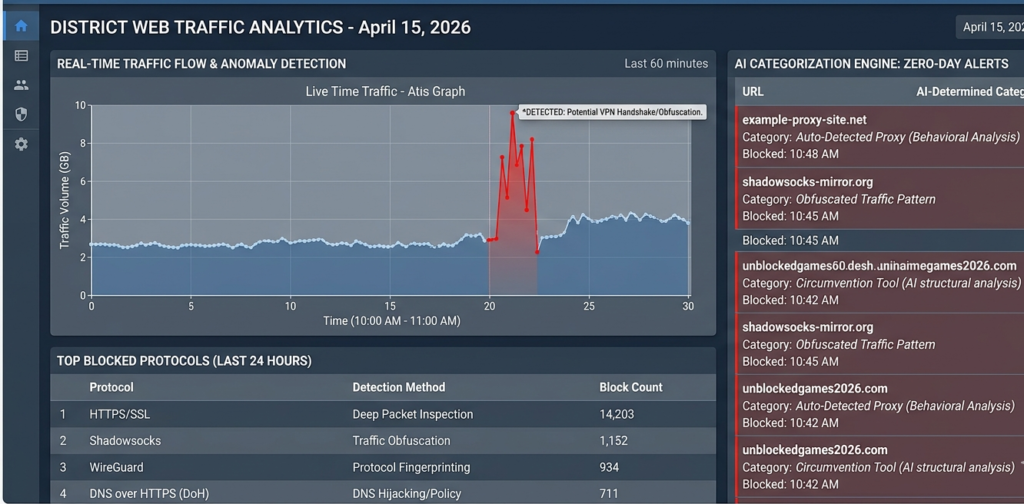
In 2026, the default school firewall (dominated by industry leaders Lightspeed Systems, GoGuardian, and Securly) no longer uses a list of “bad URLs”. Instead, they use Predictive Behavioral Analysis.
The Shift to “Zero-Day” Categorization: Previously, a new proxy site could stay unblocked for weeks until an admin manually flagged it. Now, AI-powered filters evaluate the code of a webpage. If the code matches a proxy (even for a never-before-seen URL), the website is automatically blocked, or “Zero-Day” blocked.
AI-Supported “Prompt Capture”: A major 2026 update in school monitoring is the integration of AI Governance. Filters such as GoGuardian Hall Pass will now track both your movement and what you write in AI chatbots such as ChatGPT or Gemini. If you use these tools to “create a proxy script” or “summarise a blocked website”, the filter raises an alert to the school.
The Most Recent School Website Blocking Statistics
- Knowing the extent of restrictions on the internet will help you understand why unblockers are so popular today.
- More than 70% of internet users worldwide are subject to some type of internet restriction, including in schools
- Around 75% of teachers report students using workarounds to bypass school filters
- Globally, 81 new internet restriction cases were reported in 2025, indicating a growing trend of online censorship
- Hundreds of categories of websites are often blocked in schools, including social media, streaming and even educational resources
- Record Challenges: 4,235 unique titles were challenged in 2025 by the American Library Association (ALA), the second-highest number ever recorded.
- The Role of Pressure Groups: 92% of challenges in 2025 were initiated by pressure groups and governmental officials, a 20% increase over 2024.
- The Decryption Reality: In 2026, more than 65% of US school districts used SSL/TLS Inspection. This allows the school to “man-in-the-middle” your HTTPS encrypted traffic to determine the content of the web page you are reading.
These statistics indicate that blocking of websites is on the rise, not in decline, and unblocker software is in high demand.
Why Traditional Methods No Longer Always Work
Some years back, simple workarounds such as using HTTP/HTTPS or proxies were sufficient. But today, school networks employ:
- Deep Packet Inspection (DPI)
- AI-based filtering systems
- Custom DNS blocking
- Firewall-level restrictions
This means: Some unblockers don’t work in all schools. For instance, the DNS method will work for some schools but not others that have advanced settings.
Advanced Bypass Protocols: The 2026 “Stealth” Toolkit
If the school can “see” the VPN, it will block it. To get past a 2026 firewall, you need an Obfuscated Protocol.
Shadowsocks and V2Ray (The “Swiss” Standard): Shadowsocks is the most popular option for highly-censored regions. A VPN has a “handshake” that firewalls are able to detect, but Shadowsocks disguises your traffic as normal HTTPS traffic.
- 2026 Update: The latest version of Shadowsocks also supports “IP Shuffling” which regularly changes the destination IP so the firewall cannot track down the proxy.
Post-Quantum WireGuard: The advent of quantum computing meant that in 2026, Mullvad and NordVPN had completely switched to Post-Quantum (PQ) Encrypted WireGuard.
- Why this is important for school: PQ-WireGuard is much faster and more “noise-tolerant”. It can stay connected even with school Wi-Fi that limits or is “noisy”.
DNS-over-HTTPS (DoH) vs. Encrypted Client Hello (ECH): DoH encrypts your DNS requests, but the firewall can still see the Server Name Indication (SNI) – the name of the website you’re accessing.
- The 2026 Solution: Browsers with Encrypted Client Hello (ECH). This conceals the SNI, preventing the school from being able to determine which website you are trying to access during the “handshake” phase.
The Chromebook Crisis: Solving ChromeOS 120+
School unblockers are mostly focused on Chromebooks. Google has released new “Chrome Enterprise” rules in 2026 which make it harder to install extensions.
Method 1: Bypassing with a “Linux Container” (Crostini): If your school did not turn off the “Linux (Beta)” option
- Turn on the Linux development environment.
- Install a Linux browser:
sudo apt install firefox-esr.
Why it works: The Linux container may run on a virtual network bridge. The school’s “GoGuardian” extension is in the ChromeOS layer, but it often doesn’t work inside the Linux container, so you can use it.
Method 2: Browser-in-Browser (The “Cloud Desktop”): Sites such as App-on-Fly or Hyperbeam create a virtual browser.
- Technical Tip: The school filter only notices a connection to a “Productivity Tool” (the cloud server). So, in that window, you are using a computer in the data center in Virginia or Oregon that has no school filters.
The Decentralized Web (DWeb) & IPFS
Probably the most “unblockable” way of 2026 is the InterPlanetary File System (IPFS). IPFS is a peer-to-peer (P2P) network: files are stored on thousands of computers around the world.
Using IPFS Gateways (Updated 2026): Since April 2026, IPFS has been much faster and more reliable, with the launch of Kubo 0.41.0. To visit blocked-site.com,You look up the “CID” (Content Identifier) of the site and then use a “Gateway”.
- Popular Gateways:
ipfs.io, dweb.link, cloudflare-ipfs.com. - The “Unblocker”: If they block ipfs.io, there are thousands of other gateways they don’t know about. You can even set up your own “Private Swarm” to exchange files with friends, and your school server will never even know.
New 2026 Tech: “De-Res” and HTML Obfuscation
Unblocker developers in 2026 used a new technique called HTML De-Resolution. When you visit a site with a new web unblocker, it doesn’t “proxy” the site, it rewrites it.
- The unblocker grabs the code of a site, such as YouTube.
- It removes all the “YouTube” information and calls everything “Document_Section_1”.
- The school filter reads the code and sees something like a Google Doc or Wikipedia, but you see the video.
Troubleshooting: Why the Unblocker isn’t Working
Troubleshooting: Why the Unblocker isn’t Working
If you’ve tried the above solutions and you’re still blocked, then your school is probably using Hard-Coded DNS or IP-Level Throttling.
- Symptom 1: You can reach the proxy, but it doesn’t load.
Fix: Your school is probably “dropping packets” that appear to be proxies. Try a Shadowsocks proxy on Port 443. Port 443 is the port used for all secure traffic to the internet (such as Gmail and banking sites), so it can’t be blocked without disrupting the internet.
- Symptom 1: “Your connection is not private” error.
Fix: School is attempting to decrypt traffic. You need to use a Portable Browser (such as Firefox Portable) from a USB. Portable browsers bypass the “Spy Certificates” on the school computers.
Security Warning: The 2026 “Free Proxy” Danger
As a security and SEO professional, I have to tell you: Free is expensive. In a 2025 study, 42% of unblocked games and free proxy sites were found to be mining cryptocurrency in the background or stealing Discord tokens from logged-in students.
- Pro Tip: If a website requests “Allow Notifications” or “Install a Profile”, RUN AWAY. This is typically used to set up stealth tracking on your computer.
Risks of Using Website Unblockers in School
Whereas unblockers to websites may be useful but should be used wisely. Others such as VPNs and proxies, are safe in protecting the privacy of the user, whereas others may not be secure. Always remember to check whether the tool that you are working with is insecure.
It’s essential to know the dangers before using them.
- Breaking School Rules: Schools have rules. Breaking them can lead to
Warnings
Account suspension
Disciplinary action - Security Threats: Some unblockers (particularly free proxies) will:
Inject ads or malware
Track your activity
Steal personal data - Privacy Concerns: Untrusted tools can expose:
Login credentials
Browsing history
Personal information
Use safe and secure methods.
Smart & Ethical Use of Unblockers
Face it, people don’t only unblock websites for fun.
- Students Use Unblockers For:
- Accessing blocked educational resources
- Watching learning videos
- Using coding platforms
- Researching academic topics
In fact, sometimes overly restrictive filters even prevent accessing useful learning resources, resulting in more difficulty in learning.
Conclusion
The internet should be a place for exploration. Filters can be used for security, but they often prevent the necessary skills for success. By learning how these technologies work, be it a Layer 7 Firewall or IPFS Gateway, you are not only “unblocking a website”; you are learning the latest in network security.
Internet filters that are in place in schools are irritating, particularly when they block websites such as Instagram, Snapchat, Facebook, Reddit, WhatsApp and many other popular websites that are helpful. However, when armed with the right equipment, such as VPNs, proxies and DNS modifications, students will find it very easy to access restricted material without endangering their lives on the internet.
We are not just a digital marketing agency like Tech Trick Solutions, we know how the internet works, both the strategies of SEO and the online accessibility. The reason why we wrote this article is that we are experts in the field of site optimization, online security and online solutions. It may be how we get businesses to be ranked better on Google or how we can teach people to break through obstacles without incurring damage, but our background in the digital world is not limited to marketing.

Zaneek A. is a tech-savvy content strategist and SaaS marketing writer. With a sharp focus on helping SaaS brands grow smarter, Zaneek shares simple guides, smart tools, and proven tips that help businesses reach the right audience faster. When not writing, he’s testing new digital tools or breaking down marketing trends into bite-sized insights.